socks-studio

NASA’s 1976 identity guidelines

by fosco lucarelli

illustrations, industrial design, information graphics, technology, typography, world weird web

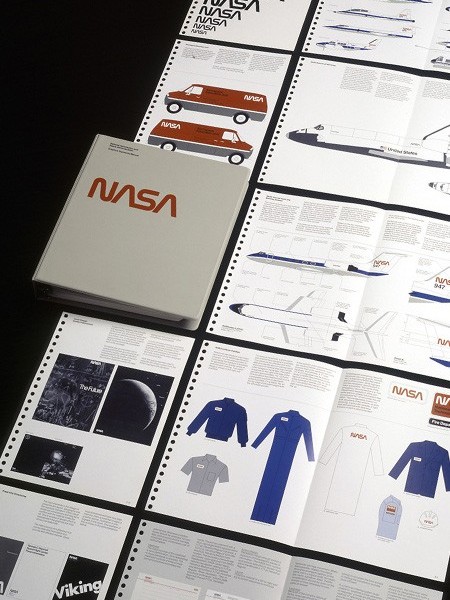
Four pages of an original copy of NASA’s identity guidelines, from when they re-branded to the ‘worm’ logo, dated January 1976.


Via:
Kottke, Tim George Design and Aisle One

“I, Impostor”: Mike Nelson’s British Pavillion in Venice Biennale 2011

by fosco lucarelli

contemporary art, literature, past futures, people

Easily the most complex work in Venice Biennale 2011, Mike Nelson‘s “I, Impostor” is a complete rework of the Neoclassical space of the British Pavillion, setting it to “make it disappear”.

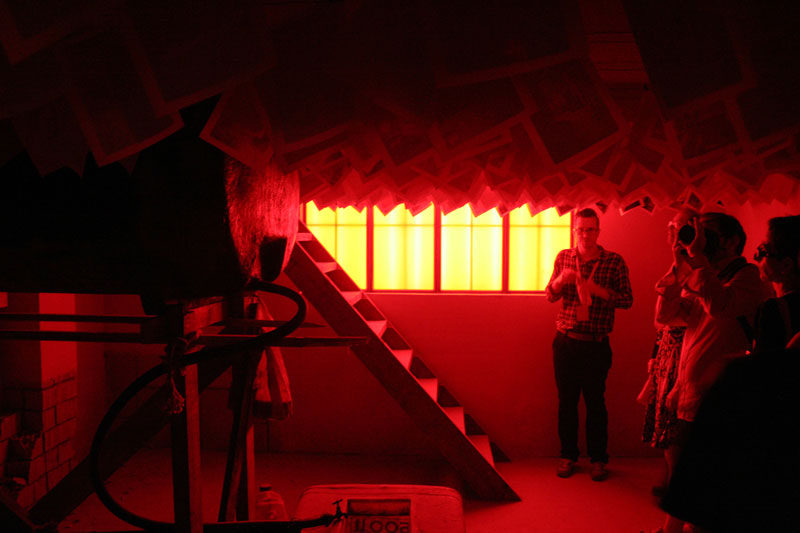
Working on claustrophobia and disorientation, Nelson decides to rebuild one of his former pieces, housed in a vast 17th century Istanbul palace, the Büyük Valide Han, translating, within the British pavillion, the original sequence of chambers, domes, stairways and arcades. He worked on memory, confusion and imagination. An actor studio discipline of “getting into character”,” invoking a half-remembered, half-imagined place using found objects”, rather than the fabrication of an architect’s exact plans. Three months of actual daring work, radically disguising the prestigious listed structure though the insertion of attics, open courtyards, systems of labyrinthic galleries.

The installation unfolds a narrative through a sequence of dim, rusty, worn spatial structures, leaving to speculation the weaving of historical facts and literary fiction.
We enter the realm of an old-fashioned, isolated and obsessive photographer, getting through his intimate darkroom, watching his hundreds of b/w prints of the Han, his personality and identity open to speculation.


An historical, larger agenda is also present, of Venice and Istanbul’s intertwined histories, of liberal capitalism and the islamic world, of mass tourism kitsch and half priced oriental finery, of the history of the two cities as allied during Renaissance.

A more intimate level is discovered by journalist Rachel Withers in her piece on the work: the reference to Orhan Pamuk’s novel The White Castle, about a 17th century Venetian who’s taken to Istanbul and enslaved by Turkish pirates. He’s bought by a scholar, his apparent alter-ego, a mutual fascination evolves in dependance and climaxes in an apparent trading of identities, with an unspecified character departing to Venice and “home”, the Turkish, possibly.

“The tense, faintly nightmarish tenor of Pamuk’s novel forms an intriguing parallel with Nelson’s work. In a Nelson installation a brick is a brick, render is render, and a fibreglass boulder is a fibreglass boulder, not a stand-in for a real rock that couldn’t be manoeuvred on site. But like Pamuk, Nelson is an allegorist, not a realist. His works ask audiences to suspend disbelief at the level of the “who” rather than the “what”. In I, Impostor, someone has been doing this building, working with these tools, taking these photographs, but who? Who is the “impostor” of the title?”

I really felt to enter into a complete literary dimension, like walking through the mind, the imagination of one man, or his alter-ego, like in Pamuk’s novel. We could read the work as a fictionalisation of the author, “a strange act of obsession”, or rather as a speculation of the artist into his inner self, a representation of his fleeting memories of Venice and Istanbul, reflected into personal and global histories.

• The art exhibition is open until 27 November.

Read more:
British Council presentation of I, Impostor
Mike Nelson at the Venice Biennale, Rachel Withers on the Guardian
Ideal Syllabus: Mike Nelson, on Frieze (In an ongoing series, frieze asks an artist, curator or writer to list the books that have influenced them)
Species of Spaces, Jonathan Jones on Mike Nelson

Photos from Artribune:


Photos by Didier at Vernissage TV:


links for 2011-07-29

by fosco lucarelli

world weird web

Venice Art Biennale 2011 quick round-up

by fosco lucarelli

contemporary art, electronic arts, illustrations, people, technology, virtual chronicles

Just came back from Venice 2011 Art Biennale.

Obviously, as everybody said, a Gesamtkunstwerk paradise, with parallel universes by Thomas Hirschhorn at the Swiss Pavillion, Christoph Schlingensief in Germany, Mike Nelson at the British Pavillion. Good works also on Austrian, Korean, Japanese and Luxembourg pavillions. French scaffoldage by Boltansky is quite impressive, but easily too rethorical. All these deserve a little more and we’ll write about later.

Very variable quality overall, like it has been always been for the Biennale, and a frankly not-so powerful main exhibition by curator Bice Curiger (ILLUMInazioni) who said to have been inspired by Bonami 2003 Biennale. Contrarily to that, she takes no risks in her focus on the classic themes of form, composition and materials.
The biggest break from the tradition, the inclusion of three Tintoretto paintings among contemporary works, (meaning that art is always contemporary), is, at its best, not necessary.

A rapid selection of noteworthy works (randomly in and out of the Biennale):

Sigmar Polke, a Curiger favorite, at the Giardini, at Punta della Dogana and at Palazzo Grassi:


Cattelan‘s thousands of pigeons (“The tourists”):


Luigi Ghirri photographs:


Urs Fischer at the Arsenale and at Palazzo Grassi:


Andro Wekua concrete and wood architectural models:


Gabriel Kuri :


Haroon Mirza :


Dayanita Singh:


Christian Marklay‘s “The Clock” :


Elisabetta Benassi‘s microfilms viewers:


Elad Lassry‘s videos:


Monica Bonvicini‘s staircases:


Ayse Erkmen‘s Water purification units:


Katharina Fritsch:


The Bounty Killart, at the Accademie pavillon:


and the on the last pavillion, apart of the works by Hans Op de Beeck, Alexander Ponomarev, Adrian Ghenie, Ryoichi Kurokawa: the robots of Federico Diaz:


Parallel exhibits: some good surprises from Pinault’s collection at Punta della Dogana and from the wonderful spaces of Ca’ Corner della Regina, rented for 6 years by the Prada Foundation. Don’t lose OMA/Koolhaas models for the new Prada headquarter in St.Isarco.

Ah, by the way, the infamous Sgarbi pavillion? Total rubbish…

And sorry for the exhibitions and the pavilions we haven’t visited, due to the only few days we could spend in Venice: Palazzo Zenobio, Padiglione Internet and san Giorgio Maggiore.
More info on these on Bird in the house

More on the national pavillions soon.

links for 2011-07-28

by fosco lucarelli

world weird web