socks-studio

Solving the difficult problem of landing on a roof

by fosco lucarelli

architecture, illustrations, past futures, technology, urban chronicles, visions, world weird web

Not much more that flight was actually invented, people soon started imagining a very possible future of regular personal flights.

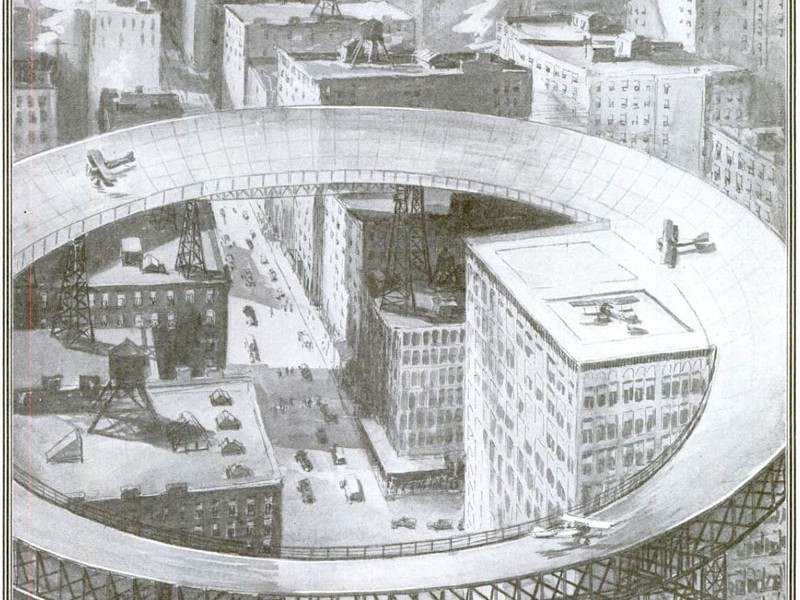
Of course, it wouldn’t be that easy to commute for work using an airplane in a big city, and in 1919 nobody invented yet an airplane that could “rise almost vertically from the ground”, (since the first helicopters dated back to the 30′s).

So how to solve this important architectural and infrastructural issue?

An article by Carl Dienstbach, on the June 1919 issue of Popular Science Monthly explains how the solution by Mr. H.T. Hanson is, really, at hand: “He would build the platform in the form of a circular, high-banked track — a track that would be constructed of light but strong iron gratings, so that sun and air would still find their way to the streets below.”


Once landed: nothing easier than use one of the big elevators contained within the buildings upon which the circular runways rested, park the airplane and start a new work day at the office.


We discovered this amazing retro-vision on the always inspiring “Paleofuture – the future that never was”, which just moved from the old address to the Smithsonian. Take a read and upgrade the bookmark.

The Social Life of Small Urban Spaces – William H. Whyte

by fosco lucarelli

architecture, past futures, social, urban chronicles

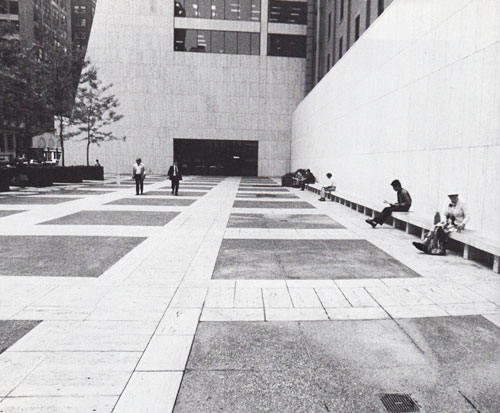
Some time ago, friend Luca Diffuse sent us a smart 1979 documentary called The Social Life of Small Urban Spaces, directed by William H. Whyte.

They apparently put the whole thing up on YouTube. (Seen on Kottke, too).

So here it is: a witty film about social spaces and how they are used by people, why they work, why they don’t, starting from New York’s Seagram Plaza. Enjoy:

The Museum of all Museums, Federico Soriano & Asociados

by fosco lucarelli

architecture, visions

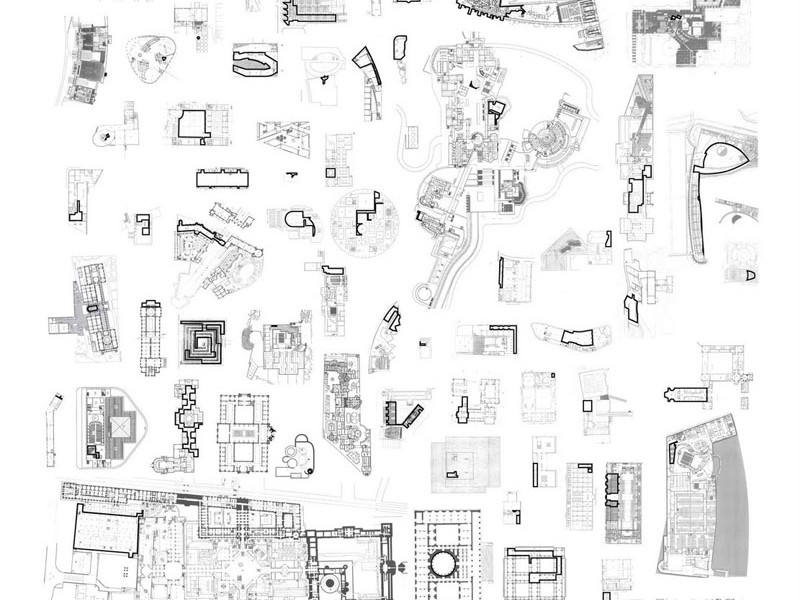
Only a few buildings emerge outside, in Soriano’s entry for the new Taipei City Museum of Art.

But once inside, hidden under a garden of bamboo, you would discover a Piranesian collection of hundreds of museums’ fragments, a postmodern Campo Marzio of interiors.

Boutade or not, we wonder if a new typology is born, the museum as a diachronic taxonomy of museums.

Click to zoom.


Via: Afasia

The implausible futurist: Steven M. Johnson

by fosco lucarelli

architecture, contemporary art, illustrations, industrial design, satire, social, technology, urban chronicles, visions

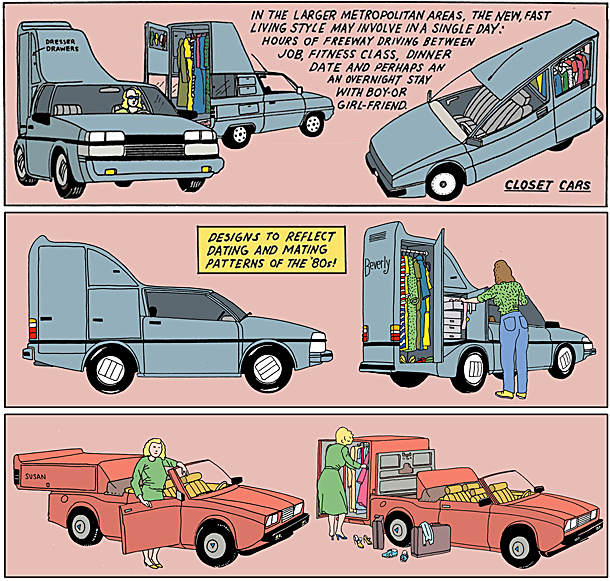
Since the 70′s, Steven M. Johnson, (not to be confused with the almost homonymous Steven B. Johnson ) amused himself drawing utopian products on paper, designing alternative scenarios in a style for he was once described by Dwell editor Allison Arieff as “R. Crumb meets Buckminster Fuller”.


Working as a former urban planner and future trends analyst for Honda, he developed his passion somewhat alongside, until he was asked by Neatorama.com to produce one new invention each week. Concepts – yet lacking patents – like shoes with headlights and left and right directional signals, front and back bras, a human powered washing machine, pre-scratched cars, thought as possible solutions to real or imagined problems.

In fact his first book “What The World Needs Now”, was even designed to spoof an L.L. Bean catalog.


During the 90′s he shifted his attention to social issues, trying to solve them.
Here’s a house with a swimming pool moat, a way for him to address crime prevention:


Until he worked on his most utopian idea, but possibly the one we could see materialize: “a vast intercontinental highway system that is designed for solar, electric, and other qualifying benign vehicles“.


Via: Archinect

Laura Barnard, High Speed, Patterns

by fosco lucarelli

architecture, illustrations

Laura Barnard, illustrator, lives and works in the Uk.

She specialises in intricate “cityscapes and patterns“.

High Speed

A entirely plausible strategy about where some high speed railway lines could go.


Patterns

Various repeating patterns of varying density and subject created for various things.

“If there is any feasible way for me to clothe myself in these, Von Trapp family style, I will find it.”