socks-studio

“A Home is not a House”, by Reyner Banham and François Dallegret, 1965

by fosco lucarelli

architecture, illustrations, past futures, people, social, technology, visions

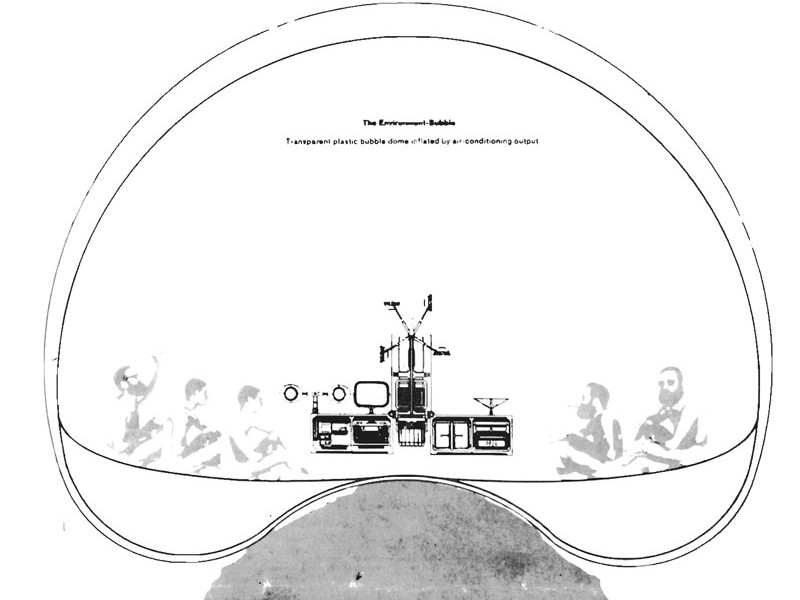
Six drawings have been realized by French architect and artist François Dallegret when asked in 1965 by Magazine Art in America to illustrate the article by Reyner Banham “A Home is not a House” (Art in America #2, 1965).

In A Home is Not a House, Banham attacks the North-American houses, built without a proper protection from cold and warm weather, based upo a widespread use of heating pumps, a general waste of energy and the production of an “environmental machinery”.

It starts like this:

“When your house contains such a complex of piping, flues, ducts, wires, lights, inlets, outlets, ovens, sinks, refuse disposers, hi-fi reverberators, antennae, conduits, freezers, heaters – when it contains so many services that the hardware could stand up by itself without any assistance from the house, why have a house to hold it up?”

The drawing “Anatomy of a dwelling” shows a huge network of cables and tubes, an accumulating “baroque ensemble of domestic gadgets” between the sky (with a Tv antenna) and the earth (a septic unit).

Naked and sat around a technological totem, Banham and Dallegret appear in “Transportable standard-of-living package” a mobile habitat environmentally friendly, equipped by solar panels, for an hippy yet hypertechnological nomad youth.

Find a copy of the original article in pdf on Studio 4 Postindustrial.
Transcribed text here.

Read more: “Ecology without the Oikos: Banham, Dallegret and the Morphological Context of Environmental Architecture” on field-journal.org

The drawings are the following, and they now belong to the Frac collection:

Click to zoom:


Un-House. Transportable Standard-of-Living Package


A home is not a house


Anatomy of a dwelling


Power membrane


Super coupe de long Week End


Trailmaster GTO


And here an excerpt from the review by Charles Jencks:

“The two ideas behind this are to give everyone a standard of living package containing all the necessities of modern life (shelter, food, energy, television) and to do away with all the permanent structures of building, and men would not be constrained by past settlements.

the advantage of pushing present tendencies to such extremes is that the extremes indicate possibilities not otherwise exploited and present alternatives in a clear light. perhaps the furthest limit in increasing ephemerality is either religious mysticism, or a mood controlled environment which is induced entirely in the mind – through drugs, and electrodes implanted on the brain. in this situation, all artifacts would disappear entirely and the only thing left would be a contemplative trance having much the same advantage over tangible things that st. bernard pointed out over eight centuries ago.

it may be doubted whether the mood controlled environment was exactly what he was proffering, but there can be no doubt – what with the eight century trend toward a sensate culture and the present possibility of stimulating the pleasure centres of the brain – that certain groups will be tempted to construct it. what exactly it would look like is best left to the imagination.”

Charles Jencks, Architecture 2000, 1969


Wheatstone Wave Machine, c. 1875, Physics Dept., Union College, NY. maker: Rudolph Koenig

by fosco lucarelli

sounds, synthesizers, technology

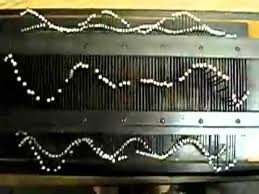
In the late 1840s Charles Wheatstone developed a moving mechanical model for demonstrating wave properties of light and sound. It displayed both vertical and horizontal waves with varying differences of phase. Wave-shaped wooden sliders moved along the axis causing bead-wire units (with both vertical and horizontal components) to move in a wave motion. This is a very brief, incomplete demonstration of the Wheatstone wave machine in action. References: Rudolph Koenig’s 1889 catalogue, no. 263b Julian Holland (2000). “Charles Wheatstone and the Representation of Waves, Part 1 & 2, Rittenhouse, vols. 13, 14, pp. 86-106, 27-46.


La città capitalista, by Giovanni Brino

by fosco lucarelli

architecture, illustrations, industrial design, italians, literature, past futures, politics, urban chronicles

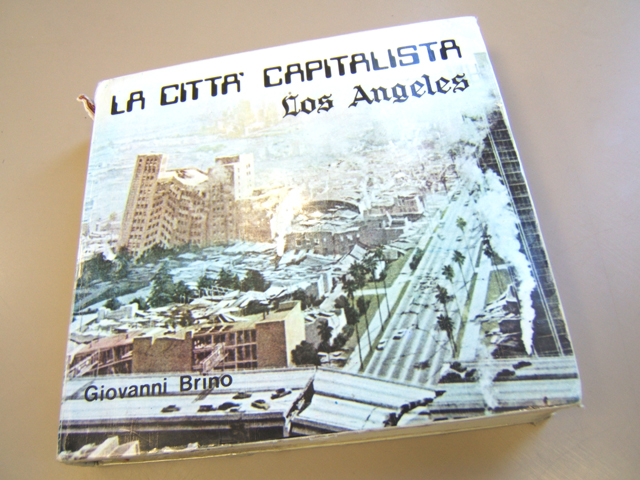
An ambitious title for a 1978 obscure yet brilliantly illustrated book by italian scholar studying urban planning in UCLA Giovanni Brino.

Just reviewed on Archinect by Orhan Ayyüce. Here his flickr set on the subject.

Love the titling done with that 70′s digital font, analogous to the one in the “talking” car in 1972′s “Reyner Banham loves Los Angeles“.


Via: Ethel Baraona

150 years of technological evolution from Italy

by fosco lucarelli

italians, past futures, technology, visions

Vittorio Marchis, teacher of History of Technology and History of material culture, is the author of a book that will be published next Nov 2nd, called “Centocinquanta (anni di) invenzioni italiane” (150 (years of) Italian inventions), a selection of 150 patents by italian inventors from 1851 to today.

A strict selection of just one patent each year, the book doesn’t just revolve around famous inventions / inventors, but choses to present also less known propositions by simple workers, soldiers, sport players, etc…

Check also the interesting Marchis’s autopsies of machines“.

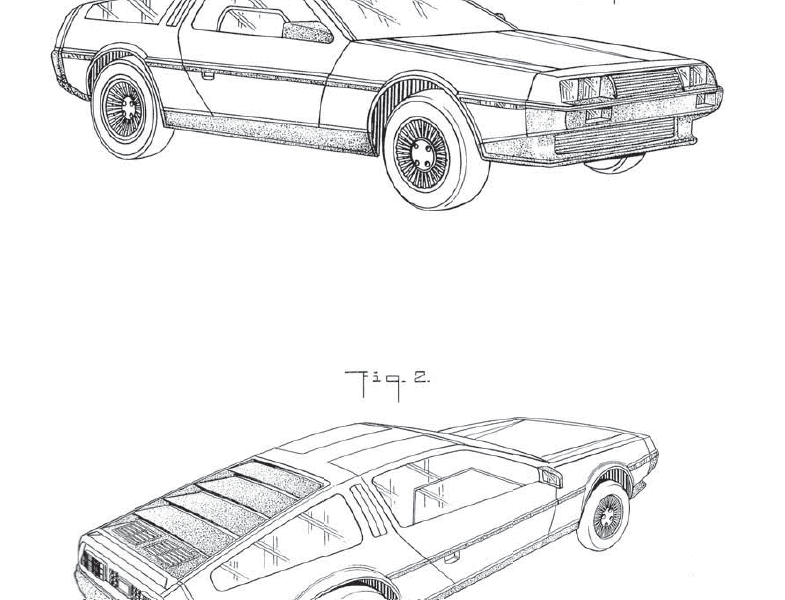
Did you known that the iconic DeLorean DMC-12 featured on Back from the future, was an original design by Italian Giorgietto Giugiaro?

Here some drawings from the original article on Post.it:


Ruins on the abyss

by fosco lucarelli

architecture, electronic arts, industrial design, land art, movies, past futures, technology

Ethel Baraona, whose always interesting articles and links we particularly missed during these two weeks of no-internet, points towards this post on io9 and How to be a retronaut, about the fascinating ruins of the set of James Cameron’s 1989 sci-fi flick The Abyss.

From io9:

‘James Cameron’s undersea set for the 1987 filming of The Abyss at the unfinished Cherokee Nuclear Plant outside of Gaffney, South Carolina.

‘Cameron’s crew constructed one of the largest underwater film stages ever built and — because of the sheer cost of disassembling it — were forced to abandon it to the elements for 20 years.

‘The seven-million-gallon, forty-foot-deep set was eventually demolished in 2007. These shots were taken from 2003-2004.’

Some photos here, check the two sites for more, and here the site as it appeared in 1994.