socks-studio

Computational Politics and Architecture: From the Digital Philosophy to the End of Work

by fosco lucarelli

architecture, politics, technology

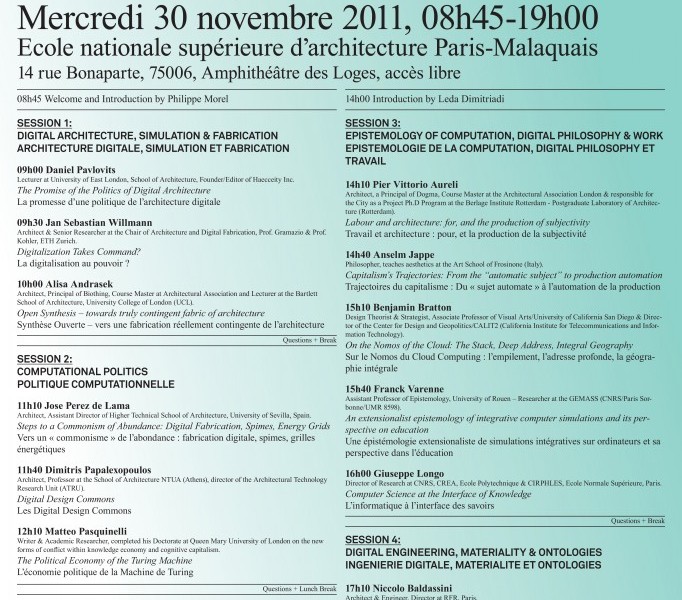
An interesting symposium will take place tomorrow at the Ecole Nationale Superieure d’Architecture de Paris Malaquais. (14 rue Bonaparte, 75006, Amphithéâtre des Loges)
Among the intervenants: Pier Vittorio Aureli, Matteo Pasquinelli, Jose Perez de Lama.

Here’s the program online.
Here’s a pdf with the program.
Here’s a bio of all the intervenants.

As a concluding event for the 10th Anniversary of the creation of the Ecole nationale supérieure d’architecture Paris-Malaquais (ENSAPM) the conference Computational Politics and Architecture: From the Digital Philosophy to the End of Work will focus on recent developments in which computation has redefined more and more human activities. Such moves cannot be understood only through an inquiry into what has been called digital, numerical or computational architecture, neither through the sole survey of the shift towards network societies. As shown by Giuseppe Longo, those evolutions have taken the shape of a “new symbolic universe” with infinite ramifications. This universe, made of computation conceived as a symbolic form, blends together abstract activities such as philosophy as well as very concrete ones, like labor, whether or not in the realm of an industrial context. By its double quality of symbolic universe and of scientific apparatus, it bears on our philosophical conceptions – the shift in our relation to nature, now mediated by computer simulations, has already become a deep phenomenon – as well as on our daily practices and so called necessities. Among those, the one of labor, which has a lasting history of critic and opposition, precisely in some XXth century architectural avant-garde, has recently appeared as an ideology instead of an inescapable natural fact. New theoretical endeavors in that direction are available, such as the ones of Anselm Jappe, Robert Kurz et al. with their Manifesto against Labour (Gruppe Krisis, 1994). The novelty of those critics is that they do not attempt to revamp the end of work on the premises of an umpteenth technological utopia, but they participate in a lucid analysis of a series of contradictions linked to the evolution of contemporary technologies and their political consequences. It goes without saying that these consequences, presented long ago by Norbert Wiener to unions in the U.S, are still of utmost actuality. Thanks to the diversity of the speakers, who all have developed lines of thought articulating technological and scientific transformations with stakes larger than those transformations, the conference will open important paths to students in order to enhance a rigorous theorization of contemporary architecture and its relationship with the global environment.


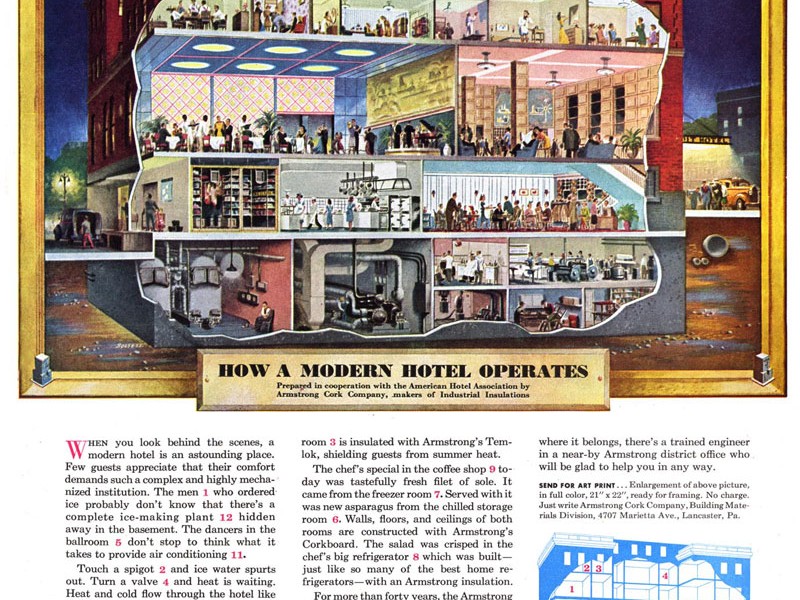
Technical Cutaways, 1940s, By Frank Soltesz

by fosco lucarelli

architecture, illustrations, information graphics, past futures, technology, urban chronicles

Frank Soltesz, illustrator.

Click to zoom.


frank soltesz


frank soltesz


frank soltesz


frank soltesz


frank soltesz


frank soltesz


Via: Retronaut

Living as form

by fosco lucarelli

contemporary art, electronic arts, politics

I just stumbled upon this project by the guys at Creative Time, that unfortunately lasted only from September to October, but that culminate in a book, out in January 2012.

Living as Form is an international project based in NYC, “exploring over twenty years of cultural works that blur the forms of art and everyday life, emphasizing participation, dialogue, and community engagement”, through a series of conferences, debates, curatorial activities and an archival-site

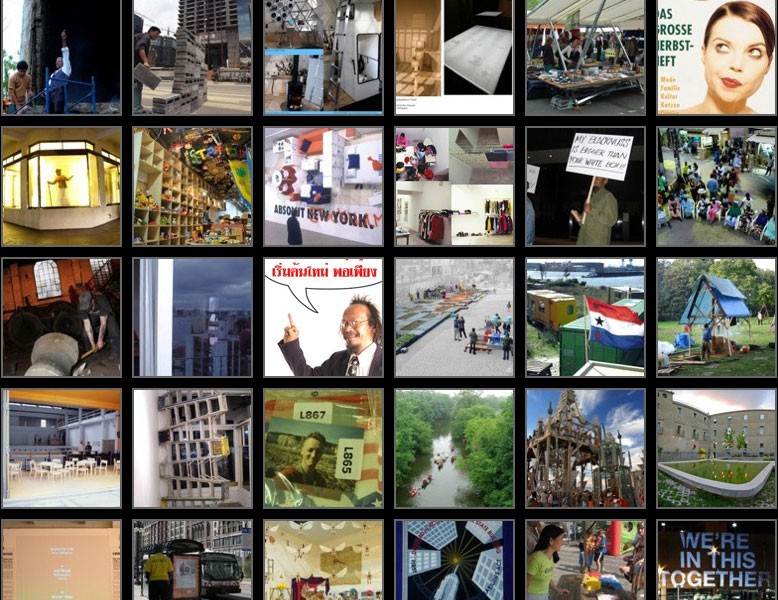
Apart from the upcoming book, my intention is to address you to their Archive of Socially Engaged Practices from 1991-2011, a database showing 350 activism projects by artists, writers, advisors and researchers during the last 20 years.


Next: a further description of the project:

Living as Form provides a broad look at a vast array of socially engaged practices that appear with increasing regularity in fields ranging from theater to activism, and urban planning to visual art. The project brings together twenty-five curators, documents over 100 artists’ projects in a large-scale survey exhibition inside the historic Essex Street Market building, features nine new commissions in the surrounding neighborhood, and provides a dynamic online archive of over 350 socially engaged projects.

Living as Form will culminate with a book, co-published by Creative Time Books and MIT Press, that will highlight projects from the exhibition archive, as well as commissioned essays from noted critics and theorists in the field, including Carol Becker, Claire Bishop, Teddy Cruz, Brian Holmes, Maria Lind, and Shannon Jackson. Detailing some of the most important socially engaged projects from the last twenty years, this unique archive will provide key examples, allow insights into methodologies, contextualize the conditions of site, and broaden the range of what constitutes this form. Living as Form: Socially Engaged Art from 1991-2011 will be out in January 2012, and is available for pre-order from the MIT Press.

Read more on Creative Time / Living as Form

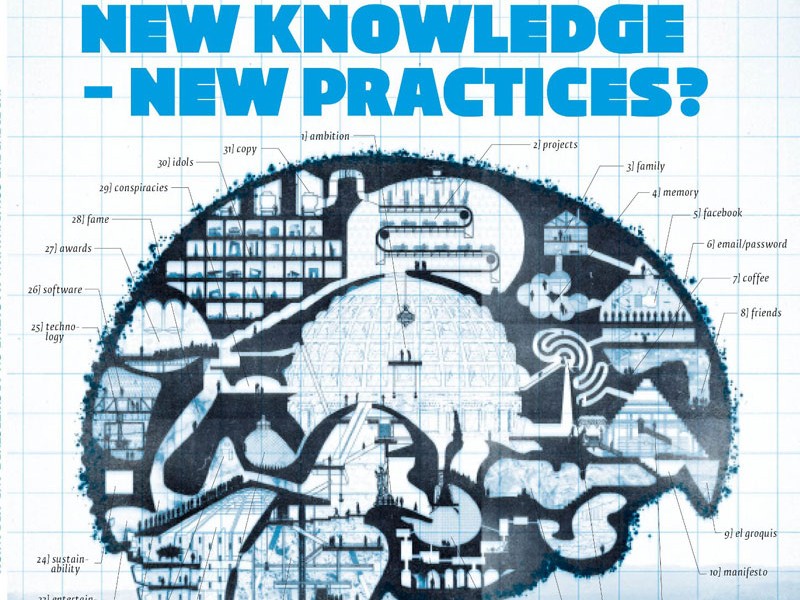
“The Architect’s Brain”, illustration by Point Supreme for Conditions

by fosco lucarelli

architecture, illustrations, information graphics

Conditions is an indipendent scandinavian magazine for architecture and urbanism.
This is the cover for the upcoming issue 9 “New Knowledge / New practices?”, by Point Supreme Architects.


Via: Joana Sá Lima on fb

B-Side, Designs by Felix Pfaeffli

by fosco lucarelli

illustrations, magazines, sounds

Feixen is the graphic design work of Felix Pfäffli. Felix was born in 1986. In 2010 he graduated and started his own studio «Feixen». In the summer of 2011 he was appointed as lecturer at the Lucerne School of Graphic Design to teach in the fields of typography, narrative design, and poster design.

Since 2011 he is also a member of the «Detective Bureau» which is an alliance of graphic designers, illustrators and politically highly committed people, but also a space for young art, discussion, design and coffee.

This is a collection of posters – t-shirts, brochure, made for different editions of the B-Side Festival.


The A-Side Destroyer: a machine that destroys the A-Side while playing the B-Side: