socks-studio

Weaponized Architecture by Léopold Lambert

by fosco lucarelli

architecture, go public, magazines, people, politics, social, street, urban chronicles, visions

Léopold Lambert‘s Weaponized Architecture, an “analysis of Israel’s architecture of colonization in the context of global trends in architecture and urbanism, (that) uses architectural design as a tool to highlight and subvert the spatial constraints imposed on Palestinians living in the West Bank” has just been published by DPR-Barcelona.

The book claims the inherent violent nature of architecture and ultimately advocates the instrumentalization of these characteristics as a manifestation of political struggle.


Waiting for a full reading, here’s an excerpt from interview that the author gave to the blog Arena of Speculation.

Léopold Lambert: “I resolutely oriented my research in a very general realm as I wanted to make a point about something absolutely inherent to architecture, which is that architecture is never politically innocent whether it has been conceived as a political weapon or not. I thought that many research studies had been made around this thesis but was always disappointed to see that architecture was always considered at a symbolic level or that its weaponization needed to be activated somehow. What I wanted to really insist on is the fact that architecture is violent in essence –the act of transforming lines into walls etc.- and that the conditioning and use of this violence was the political act inherently involved.”

“I would like architects to understand that no line they trace can possibly be innocent –which explains the subtitle of the book: The Impossibility of Innocence.”

“Disobedience appears when there is a discrepancy between a personal or collective ethics and the transcendental content of the law.”

Full interview here.
Weaponized Architecture on DPR-Barcelona.

Read more:
Weaponized Architecture, and The Funambulist, two blogs by Léopold Lambert.
Resistive Operations, on the Funambulist.
Subtopia, Bryan Finoki’s blog.


Here’s the book’s index:

INTRODUCTION: VIOLENCE ON THE BODY

ARCHITECTURE IS A WEAPON
- Chapter 1: Military Architecture
- Chapter 2: State of Exception
- Chapter 3: Urbicide
- Chapter 4: Architecture of Safety
- Chapter 5: Capitalism’s Architecture
- Chapter 6: Resistive Architectures
- Chapter 7: Smoothing and Striating Space
- Interview: Bryan Finoki

ISRAELI COLONIAL APPARATUSES
- Introduction
- Chapter 1: Israeli Separation Barrier
- Chapter 2: I.D.F.’s Road Checkpoints
- Chapter 3: Israeli Civil Settlements
- Chapter 4: Segregated Infrastructures
- Chapter 5: Areas of Control
- Chapter 6: Militarized Destructions
- Chapter 7: Extreme Urban Example: Hebron
- Interview: Raja Shehadeh

AN ARCHITECTURAL DISOBEDIANCE
- Introduction
- Designed Project

CONCLUSION: SYMPATHY WITH THE OBSTACLE

BIBLIOGRAPHY

ACKNOWLEDGEMENTS

APPENDIX /// LOST IN THE LINE
- Introduction
- Graphic Novel


Photos:

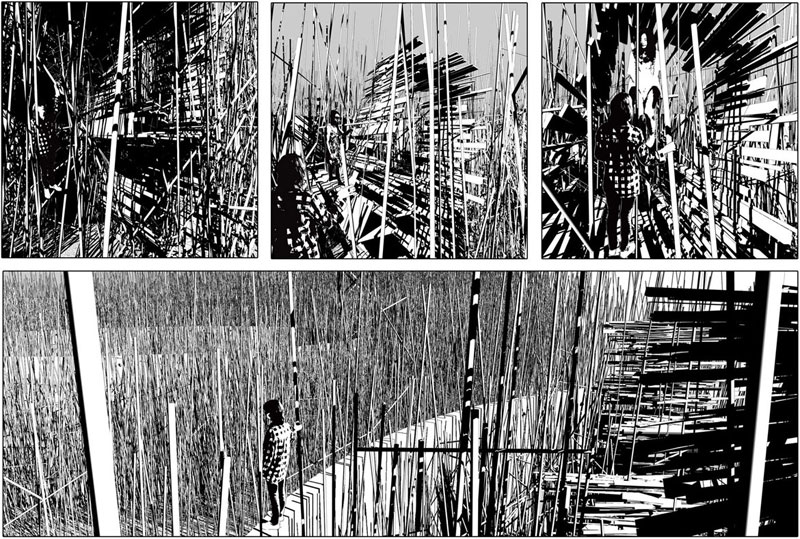
01: Fictitious representation of the power of the line in the physical world as well as an attempt to use it as a weapon: the line here becomes porous and hosts in its “thickness” a three-dimensional labyrinth whose control has escaped from its creator. Page extracted from the graphic novel Lost in the Line (2010) (Léopold Lambert/DPR-Barcelona, 2011)

02: Metaphorical map of the West Bank/East Jerusalem as an archipelago. Islands are embodied by Area A and B, the sea consists in territory controlled by the Israeli Army (+ Jordan on the extreme East) and reefs represent the Israeli civil colonies. (Léopold Lambert/DPR-Barcelona, 2011)

03: Hebron is the unfortunate most illustrative example of the oppressive power of architecture. The Palestinian market street, which has seen many of its merchants evicted from their shops constitutes a dangerous corridor surmounted by an Israeli settlement inhabited by the most violent part of the Orthodox Jewish population. The net seen on the photograph has been set-up in order to avoid the various objects thrown by this settlement’s windows and roof to hurt the Palestinian population. (Léopold Lambert/DPR-Barcelona, 2011)

04: Representation of the architectural project Weaponized Architecture in Area C near Salfit (West Bank). From far, the building looks like a fragile Bedouin encampment when in fact, the layer of tents hides a solid and effective Qasr (قصر)
The Qasr (قصر) is composed by three layers: An upper layer of tents camouflages the building as well as provides shade to it. A surface layer claims a piece of territory via a shotcrete uneven terrain which is used as a small agricultural platform. The last layer is subterranean; it can be used as a storage for agricultural goods as well as a shared shelter for the farmers and the Bedouins. (Léopold Lambert/DPR-Barcelona, 2011)

05 to 08: Page samples from Weaponizes Architecture.

Pier Vittorio Aureli, Future of History

by fosco lucarelli

architecture

Pier Vittorio Aureli, Head of the Capital Cities Research Program and “The City as a Project” Ph.D. Program, Berlage Institute, presented April 2, 2011, at the Future of History conference at University of Michigan’s Taubman College of Architecture and Urban Planning.


A Personal Subway from Russia, with Love

by fosco lucarelli

architecture, land art, people, technology, urban chronicles, visions

Longtime I had this fascination for people spontaneously creating new artificial territories, self proclaimed republics, diy infrastructures.

Diggers, or people who literally investigate the underground to create an illusory yet concrete alternative domain, are among these, usually the more solitary. Remember the man who completely excavated the floor under his house, risking a collapse, until he was discovered by his neighbors?

Altering the foundation of what we are used to, sometimes means to question reality. In the following case, it means a life’s goal. 27 years have passed since Leonid Murlyanchik, a Russian retiree now 69, started digging a personal subway system under his house in Lebedyan. The work, which is still incomplete, is destined to connect his home to his neighbors’ houses, and the neighborhood to the local train station. The primary 6 km tunnel was originally conceived to link Murlyanchik’s house to that of Ekaterina, a girl he liked from the neighborhood.

Related:
Secret Tunneling | Underground Leisure and Smuggle for Survival, on DPR Barcelona

Via: Stefano Mirti, Colors Mag. and English Russia


‘We’re Building Assembly-Line Cities and Buildings’ – A Koolhaas Interview

by fosco lucarelli

architecture, go public, magazines, people, politics, urban chronicles, visions

Der Spiegel recently invited architect Rem Koolhaas to tour HafenCity (Europe’s largest urban redevelopment project) and to show him the new Spiegel headquarters building, a project by renowned Danish firm Henning Larsen.


Koolhaas interviews with Der Spiegel (2006 and 2008) are usually kind of funny, as the architect loves to titillate the unhidden moralism and insecurities of the German.

In fact, interviewing Koolhaas (again), means for the Spiegel to be addressed by phrases like this: “I get the feeling that what you need from me isn’t so much an interview as an hour of therapy”, and the journalist can’t help confessing his regret that “the (new) building is more powerful than those working inside it.”

Apart from mundanities, some segments of the dialogue thoroughly paint the issues of contemporary generic cities:


SPIEGEL: In “The Generic City,” you ask whether it might not be intentional that our cities are becoming increasingly similar and faceless.

Koolhaas: Yes. And the answer could be: The traditional city is very much occupied by rules and codes of behavior. But the generic city is free of established patterns and expectations. These are cities that make no demands and, consequently, create freedom. Some 80 percent of the population of a city like Dubai consists of immigrants, while in Amsterdam it is 40 percent. I believe that it’s easier for these demographic groups to walk through Dubai, Singapore or HafenCity than through beautiful medieval city centers. For these people, (the latter) exude nothing but exclusion and rejection. In an age of mass immigration, a mass similarity of cities might just be inevitable. These cities function like airports in which the same shops are always in the same places. Everything is defined by function, and nothing by history. This can also be liberating.

Koolhaas: Soulless means that it’s difficult to determine what a building wants to convey. It is difficult to pinpoint the elements that make the difference. In my essay “The Generic City,” I tried to get to the bottom of this soullessness, though in terms of entire cities rather than buildings. These days, we’re building assembly-line cities and assembly-line buildings, standardized buildings and cities.

…and of weakened ambitions of today’s architecture:


SPIEGEL: One could also describe the face of our cities as the face of neoliberalism.

Koolhaas: Under neoliberalism, architecture lost its role as the decisive and fundamental articulation of a society.

SPIEGEL: How does a society articulate itself?

Koolhaas: Take, for example, the prefabricated building. No matter how misguided this ultimately turned out to be, it actually was a very clear articulation. But neoliberalism has turned architecture into a “cherry on the cake” affair. The Elbphilharmonie is a perfect example: It’s icing on the cake. I’m not saying that neoliberalism has destroyed architecture. But it has assigned it a new role and limited its range.

Through the Metabolist project Koolhaas advocates a return to a greater government control:

Koolhaas: That’s right. The state wasn’t always the hopeless and powerless entity it is often perceived to be in the West today. We learn this from the Metabolists, who the government engaged in 1960 to combat their country’s structural weaknesses: earthquakes, tsunamis, the parceling of the country. Another interesting thing about the Metabolist movement is the fact that, despite being great individualists, its members acted as a group. Today, this possibility no longer exists. The compulsion to compete has isolated architects.

But the conversation soon shifts to the controversies of dealing with authoritarianism:

Koolhaas: (…) I’m not pessimistic when it comes to the prospects for the West, for democratic societies, and the ability to build strong statements here. The only reason I chose not to take part in the Ground Zero competition was that the project’s connection to the past was too clear for my taste. There is more willingness to experiment in China. So much is being built there — entire cities! — that greater risks have to be taken. There, failure is not a disaster.

And even one as cynical as Koolhaas can’t help complaining for the inherent frustrations of the profession:

Koolhaas: As an architect, one operates in an unstable ideological environment. What is true today can be completely wrong in five years, and in 25 years it’s most certainly wrong. Ridiculous.

An appropriate ending of the therapy: an odd yet “zeitgesty” declaration, about the new Spiegel headqurter:

Koolhaas: You’ll get used to it. But I believe you have to conquer the lobby. Buy two rugs, sew the two rugs together, then buy a third one and declare the lobby occupied. Occupy SPIEGEL!


Full interview here; German original here.
Above: pictures are from the article.

XVII Century Processions

by fosco lucarelli

architecture, illustrations, past futures, social, urban chronicles

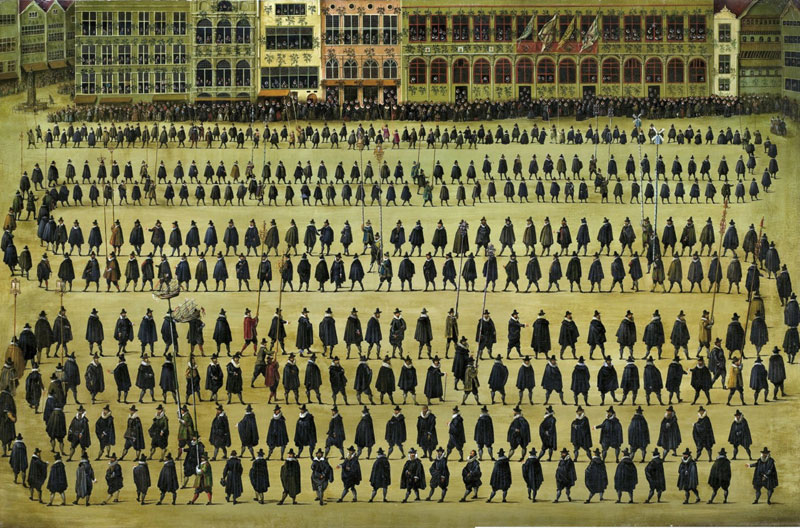
From Christie‘s: THE PROCESSION OF THE GUILDS AND THE PROCESSION OF NOTRE-DAME DU SABLON DURING THE OMMEGANCK IN BRUSSELS IN 1615, OIL ON CANVAS, A PAIR, 20TH CENTURY AFTER DENYS VAN ALSLOOT

Ces tableaux s’inspirent des oeuvres originales de Denys van Alsloot, exécutées en 1616 et conservées au Musée du Prado à Madrid. Les deux oeuvres relatent des épisodes de la fête de l’Ommegang (‘procession’ en flamand), qui se déroula à Bruxelles le dimanche 31 mai 1615, au cours de laquelle eut notamment lieu le triomphe de l’Archiduchesse Isabelle (1556-1633). Cette fête qui célébrait Notre-Dame du Sablon se déroulait sur la Grand-Place de Bruxelles et était l’occasion d’un défilé fastueux des autorités civiles, des corporations, des chambres de rhétorique, des Serments et du clergé de la ville.

Click to zoom:


Via: Species: Barocus