socks-studio

Thomas Doyle’s Distillation, Reclamation and Bearings Series

by fosco lucarelli

architecture, contemporary art, photography, psychogeographies, social, virtual chronicles, visions

New York based artist Thomas Doyle creates miniature worlds in bell jars. Doyle’s work often deals with the interplay of domestic life and destruction, love and anguish, memory and chaos, frozen in fragile instants and evoking feelings of omnipotence in the viewer, as if he’s recalling an event of the not so distant past.

“My work mines the debris of memory through the creation of intricate worlds sculpted in 1:43 scale and smaller. Often sealed under glass, the works depict the remnants of things past—whether major, transformational experiences, or the quieter moments that resonate loudly throughout a life. In much the way the mind recalls events through the fog of time, the works distort reality through a warped and dreamlike lens.

The pieces’ radically reduced scales evoke feelings of omnipotence—as well as the visceral sensation of unbidden memory recall. Hovering above the glass, the viewer approaches these worlds as an all-seeing eye, looking down upon landscapes that dwarf and threaten the figures within.

Conversely, the private intensity of moments rendered in such a small scale draws the viewer in, allowing for the intimacy one might feel peering into a museum display case or dollhouse. Though surrounded by chaos, hazard, and longing, the figures’ faces betray little emotion, inviting viewers to lose themselves in these crucibles—and in the jumble of feelings and memories they elicit.

The glass itself contains and compresses the world within it, seeming to suspend time itself—with all its accompanying anguish, fear, and bliss. By sealing the works in this fashion, I hope to distill the debris of human experience down to single, fragile moments. Like blackboxes bobbing in the flotsam, these works wait for discovery, each an indelible record of human memory.”

Thomas Doyle’s work is on show as part of the exhibition ‘American Dreamers: reality and imagination in contemporary american art’ at Centro di cultura contemporanea strozzina at the Palazzo Strozzi, in Florence, Italy from march 9th to july 15th, 2012.


Via: iGNANT and Designboom

Art Destroying Architecture: Chris Burden’s 1985 Samson

by fosco lucarelli

contemporary art, satire, technology, visions

In 1985, performance artist Chris Burden set up “a museum installation consisting of a 100-ton jack connected to a gear box and a turnstile. The 100-ton jack pushes two large timbers against the bearing walls of the museum. Each visitor to the museum must pass through the turnstile in order to see the exhibition. Each input on the turnstile ever so slightly expands the jack, and ultimately if enough people visit the exhibition, SAMSON could theoretically destroy the building. Like a glacier its powerful movement is imperceptible to the naked eye. This sculptural installation subverts the notion of the sanctity of the museum (the shed that houses art).”

Through the physical endurance of the gallery, Samson tests, on a conceptual level, the display and public consumption of art.

As both the random visitor and the art lover become complicit of the destruction of the gallery housing the piece, with this work Burden aims at questioning the role of the artist, of the art viewer and of the necessity of the art object in contemporary society.


Sorry for the bad quality of the video.


Metachaos, by Alessandro Bavari (2011)

by fosco lucarelli

animations, architecture, contemporary art, electronic arts, literature, satire, sounds, technology, virtual chronicles, visions

Alessandro Bavari is an animation and painting artist living and working in italy.

METACHAOS is a multidisciplinary audio-visual project, articulated in a short film, a set of photography and mix-technique paintings. The purpose of the project is to represent the most tragic aspects of the human nature and of its motion, such as war, madness, social change and hate.

This work recently won the prestigious Golden Nica award at Ars Electronica 2011.

At the end of the images you can find the synopsys and the statement of the video, along with the Ars Electronica Jury Statement.

alessandrobavari.com/
info@alessandrobavari.com


SINOPSYS
Metachaos, from Greek Meta (beyond) and Chaos (the abyss where the eternally-formless state of the universe hides), indicates a primordial shape of ameba, which lacks in precise morphology, and it is characterized by mutation and mitosis.
In fact the bodies represented in METACHAOS, even though they are characterized by an apparently anthropomorphous appearance, in reality they are without identity and conscience. They exist confined in a spaceless and timeless state, an hostile and decadent hyperuranium where a fortress, in perpetual movement, dominates the landscape in defense of a supercelestial, harmonic but fragile parallel dimension. In its destructive instinct of violating the dimensional limbo, the mutant horde penetrates the intimacy of the fortress, laying siege like a virus. Similar to the balance of a philological continuum in human species, bringing the status of things back to the primordial broth.

STATEMENT
METACHAOS is a multidisciplinary audio-visual project, articulated in a short film, a set of photography and mix-technique paintings. The purpose of the project is to represent the most tragic aspects of the human nature and of its motion, such as war, madness, social change and hate. An accretion of feelings that are metaphorically represented by specific visual forms, which are abstract conceptually, but concrete and tangible formally. The application of acid and monochromatic tints, besides the strong contrasts, makes everything intentionally more oppressive and tragic.

In order to obtain a more immersive and plausible version, the shot was taken adopting the camera live technique. The extreme and frenetic motion of the shoulder camera, similar to the subjective one, becomes a main constant, so that, along with the persisting cuts used to edit the video, create a bigger sense of instability and danger. In fact, thanks to the dissemination of Technology, it is possible to notice that the unconscious-esthetic potential of the shots available on Youtube, characterized by a pseudo-documentary and amateur approach, often offer an unexpected emotional involvement, which trigger an exhibitionistic-voyeuristic interchange between the author and the consumer.

The irrational gesture and action of the bodies, as if a collective form of madness controlled them, are inspired by artists like Bosch and Bruegel who, between the ‘400 and ‘500, produced an iconography where irrational images show sickly madness and pain.

The project has been realized using different techniques: live shots taken in discharged industrial sites, CGI animations, tracking and motion captures, besides various other analogical ones.

American Jeff Ensign, aka Evolution Noise Slave composed the original sound track, which has been progressively updated during the video production. The musical score was inspired by 6 separate pieces Jeff had previously created that were then combined into a hybrid. The composition was also based in part from a sonic interpretation of the ideas presented in Antonin Artaud’s the Theater and Cruelty overlaid on Bavari’s images.

JURY STATEMENT FROM PRIX ARS ELECTRONICA 2011.
Alessandro Bavari’s “Metachaos” is an impressive display of the amazing graphics that can be produced with leading-edge hardware and software. The 8-minute clip begins with a sequence of clear, geometric forms that suggest a serene world. But it doesn’t take long until it’s apparent that this was just the calm before the storm. Shadowy creatures and shockingly grotesque figures intrude into this domain rendered in black & white and sepia tones and rip it to pieces. Using the interplay of light and shadow, intentionally shaky camera movements and quick cuts, Bavari takes us on a tour de force through an unsettling imaginary cosmos that grips viewers and doesn’t let them loose. In addition to its extraordinary visuals, “Metachaos” features an impressive composed soundscape of incredibly concentrated intensity—noise elements paired with driving beats, panic-stricken screams, the rattling of bones and gale-force winds.

While some of as did not necessarily share the apocalyptic view of this film, we found that it left the most indelible impression. Narrowly passing through the first round, it grew on us, so that on repeated viewing it miraculously made its way to the top.
What starts as a cinematic, kinetik, yet clean field of geometry and bodies, gradually evolves, or devolves, into the artist’s vision of a nightmarish black-and-white world created by a continual collision of the human and the architectural form. It finally culminates in a screaming dance among the ruins. In a impressive virtuoso tour de force, Alessandro Bavari creates a constant mêlée of grime, projectile muck and dust among collapsing spaces at the stage for metamorphosing human bodies with branching limbs that seem constantly to break the architectural environment apart. Zombies with missing limb sand decaying skin and faces sometimes stand around listlessly and other times appear to engage in orgasmic sex. The human forms become insect-like and multiply in hordes across the building forms. Dust particles and snakes of turbolent, ferrous liquid finally explode into an apocalyptic ocean of flotsam and sludge.
Bavari’s few collaborators helped shape what the credit call “camera tremula” (shaky, documentary-style camera) and sound design. We commend his dedication to a singular artistic vision that is grounded in his practice as a photographer. This is a representation of a caustic end of the world, a world of a audible pain and hopeless destruction rendered with a disturbing reference to 80s-style computer-generated animation as well as 60s “actionism”.

Nø City Guide, a monumental work on Shanghai

by fosco lucarelli

architecture, technology, urban chronicles, virtual chronicles, visions

Our friend Matthieu Duperrex, editor of Urbain-trop Urbain, just released his long awaited monography on the city of Shanghai.

The Nø City Guide is a French-language, PDF and Epub (iPad ready) digital book “dedicated to the imaginary or real practice of the city”.

50 authors portray the megalopolis in a monumental book spreading over seven hundred pages, a 30x18cm format with countless links, videos and audio ressources.

“Mégalopole de vitesse et de changement permanent, Shanghai contredit la fixité et l’idéal de ce qu’on appelle encore ville. Au visiteur imaginaire ou réel, au nouveau flâneur urbain équipé de son outillage numérique, Shanghai Nø City Guide délivre une exploration loin du récit omniscient. La texture urbaine qui se tisse ainsi à propos de Shanghai devient une invitation à se constituer soi-même des approches parcellaires et éclatées, des pratiques urbaines…”

We are not sure if a version is at work for English readers, but for every further information, questions and contact, write to:

Matthieu Duperrex et Claire Dutrait
contact@urbain-trop-urbain.fr
contact@nocityguide.com
More infos here.
A pdf excerpt here.

The Nø City Guide is downloadble online at: nocityguide.com


A phrenology of the artist’s mind: Grayson Perry‘s 2004 “Map of an Englishman”

by fosco lucarelli

illustrations, information graphics, land art, literature, maps, past futures, psychogeographies, satire, visions

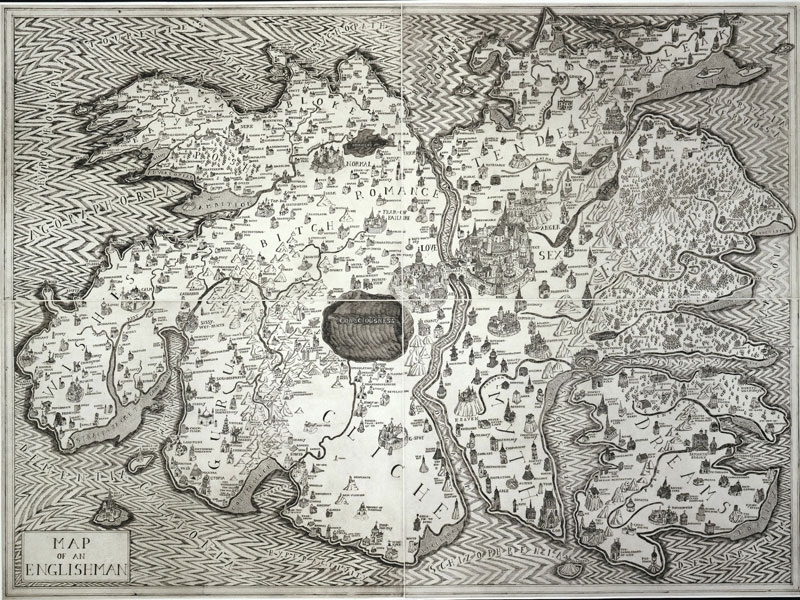
Exhibited at the Whitechapel Gallery in London, Grayson Perry’s 2004 “Map of an Englishman” is a 120 x 150 cm psychogeographical exploration of the artist’s mind.

Etched in a mock-Tudor style, an imaginary island, vaguely reminding the form of the brain, is surrounded by the seas of Perry’s psychological flaws (Schizophrenia, Delirium, Anorexia Nervosa), while the countryside is defined by the artist’s “prejudices, fears, desires and vanities” in the shape of the counties of “Sex”, “Tender”, “Cliche” or “Dreams”.

Further reading:
Stratafigura’s Grayson Perry knows where to poke
Brain Picking’s Mapping the Human Condition


Click for a 2000px-wide version of the map: