socks-studio

Microcities lecture at Cornell University, Rome / April, 19th 2012

by fosco lucarelli

architecture, politics

If you happen to be in Rome next week, we will give a public lecture together with Italian architecture office Urbanaarchitettura at the Cornell in Rome University.

We will talk about our recent works and focus on how the theoretical background of our projects is continuously intertwined with the editing of our blog.

Our lecture will be followed by Urbanaarchitettura’s and by a debate moderated by Cornell’s Prof. Luca Galofaro and Prof. Gabriele Mastrigli.

See you there!


Here are the infos:

A Dialogue Between Urbanaarchitettura and Microcities (Rome)
AAP Cornell in Rome Spring 2012 Lecture Series

DATE
April 19, 2012

TIME
6 p.m.

LOCATION
Palazzo Lazzaroni, 6 Via dei Barbieri, Rome

CONTACT
Anna Rita Flati
39-06-689-7070
arf25@cornell.edu


Architectures at the Service of Science: Jantar Mantar (The Jaipur Observatory)

by fosco lucarelli

architecture, technology

Literally meaning “Calculation Machine” the Jantar Mantar is an astronomical observation site built by Maharaja (King) Jai Singh II between 1727 and 1734 inside his City Palace in Jaipur.

The largest and best preserved of five similar devices built in Delhi and Jaipur, Jantar Mantar includes a set of fourteen main fixed instruments in masonry, designed for the observation of astronomical positions with the naked eye.

The site is still used today by Vedic astrologists and local astronomers in order to predict the weather. Its religious significance testimonies of a time when science hadn’t still completely emancipated from religion, since the ancient astronomers were also Jyotisa masters.

Further reads:

www.jantarmantar.org (a site including 3d models and animations)

Architecture in the Service of Science. The Astronomical Observatories of Jai Singh II
Text and Photographs by Barry Perlus.

Eye See: Astronomical Architecture of the Jantar Mantar, at Web Urbanist

Norman Koren photos

Galen Frysinger site

Bomhard site


The devices are major structures for measuring time, predicting eclipses, tracking stars’ location as the earth orbits around the sun, ascertaining the declinations of planets, and determining the celestial altitudes and related ephemerides.


Each instrument carries an astronomical scale and it represents a major architectural innovation at the service of science. The Giant Sundial, known as the Samrat Yantra (The Supreme Instrument), standing with its 27m, allows to catch the shadow movement of 1mm/s , its shadow carefully plotted to tell the time of day. Its face is angled at 27 degrees, the latitude of Jaipur. The Hindu chhatri (small cupola) on top is used as a platform for announcing eclipses and the arrival of monsoons.

The huge structures were designed with the aim of increasing the accuracy, altough the Sun’s penumbra of 30mm devoids of any significance the 1mm increments of the Samrat Yantra sundial. Additionally, subsidence of the foundations misaligned the instruments.


Walls as Rooms: British Castles and Louis Khan

by fosco lucarelli

architecture, past futures

Louis Kahn was known for his interest in Scottish Castles, by which he elaborated the distinction between ‘served’ and ‘servant spaces’, “with great central living halls and auxiliary spaces nestled into thick outside walls”. The castles were a strong inspiration for later works such as the Unitarian Church in Rochester and Erdman Hall at Bryn Mawr College.

Deep set shutters and a general work on the façade’s thickness were introduced during the design process of Fisher house. From the thesis “LOUIS I. KAHN’S FISHER HOUSE: A CASE STUDY ON THE ARCHITECTURAL DETAIL AND DESIGN INTENT by Pierson William Booher”:

“The ‘deep set shutters’ are a series of recessed window pockets, slight multifunctional intrusions into the space that give depth to the façade while creating an interior shelf. The most practical aspect of the window recessions is a sense of privacy and humanity they provide, creating variations along the facades that cast shadows and give a texture to the form. Not only do they break the planarity of the façade and bring the exterior inside, but they allow for an open window during a heavy rainstorm, as their form naturally protects against water infiltration.”

For more informations on the single castles, have a read at the Spanish “Tectonica Blog“: the guys there are doing a very thorough survey of construction types, among which you can find the “military” category.

Related, on Deconcrete:
Inhabit a Wall
(An intesting comparison between modern stadium and British fortresses).

Here you can find a series of drawings of British castles.


Khan’s sketches of castles


Hedingham Castle
A “motte & bailey” castle located in the county of Essex, England.
A Norman military construction with predominant strongholds, built between the XIth and XIIth centuries, by order of Baron Aubrey de Vere I.
Up on a hill stands the core construction, the keep, with a height of 35m. It has four floors, a thick excavated wall and a large lobby whose central arch occupies two floors.


Dover Castle
Known as the “Key to England” is located in a strategic location near Dover, Kent County, England and was founded in the XIIth century.


Early traces of iron age and roman fortifications.
Important extensions began during the time of Henry II: the outer defensive fronts and keep (safe indoor area) belong to this period, and were built by the engineer Maurice. After the tempted siege by Louis VIII of France in 1216, a vulnerable door in the North side was implemented with a defense mechanism built underground beneath it and two other doors were added. During the siege, tunnels allowed the English to pass beneath enemy lines and attack them from behind.

In Tudor times, the vulnerability against gunpowder forced Henry VIII to dig a moat. Later events, during the english civil wars and the Napoleonic wars brought to the weakening of the structure, but later works converted the entire city of Dover into a “garrison town”, with tunnels located 15m deep underground, widely used during World War II.


Orford castle
Suffolk, England, 1165-1173


The design of the keep is termed “One of the most remarkable in England”, according to historian R. Allen Brown. A 27m high circular central tower with three rectangular towers built out from the 15m wide structure. The proportions of the tower are very precise and the ratio follows that of many English churches of the period.
Originally a stronger defense to the keep was given by an outer curtain wall with four flanking towers and a fortified gatehouse.

A traditional theory argued the castle was a transitional military design, due to the fact that some elements, like the square angled buttresses and the chambers in the wall created blind spots for the defenders and weakened the structure and were thus hard to justify for military purposes.

Recent historians questioned this theory, believing that the design of Orford Castle was driven by political symbolism. According to Heslop, King Arthur intended to idealise his alleged Roman or Greek links through an elegant architecture, whose angular features resembled the Theodosian Walls of Constantinople, (then the idealised image of imperial power), and the keep as a whole, including the roof, may have been based on a hall that had been recently built in Constantinople by John II Komnenos.


Trim Castle
County Meath, Ireland

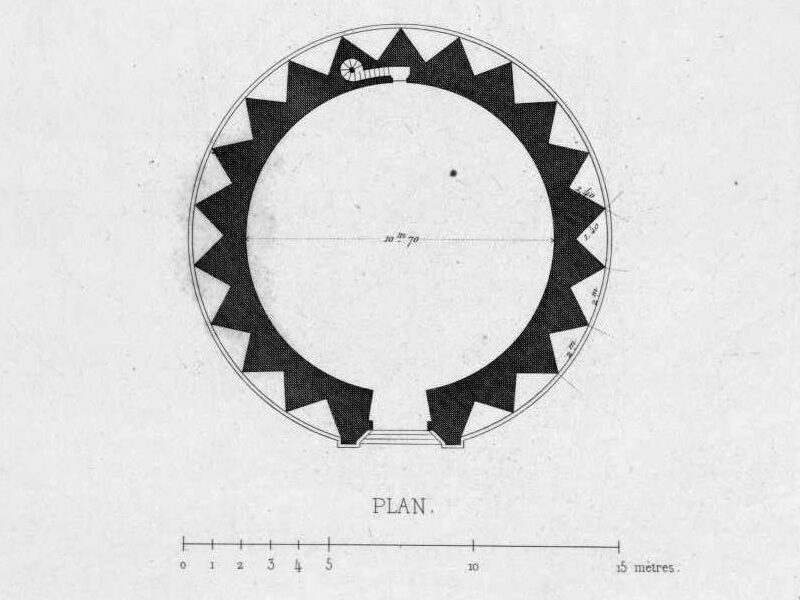
A unique keep design, the three-story tower consists in a cruciform shape, with twenty corners.


Peak Castle
Derbyshire, 1176, construction instigated by Henry II.
The keep occupies the southern corner of Peek Castle.
Its plan is square, measuring less than 12 by 12 m , and the parapet is 15 m above the keep’s base; as the ground is uneven, on the other side it rises 10.5 m above ground level.


Tattershall Castle
Lincolnshire, England
Tattershall Castle has its origins in either a stone castle or a fortified manor house, built by Robert de Tateshale in 1231.This was largely rebuilt in brick, and greatly expanded, by Ralph, 3rd Lord Cromwell, Treasurer of England, between 1430, and 1450.
A simple design of four floors, slightly increasing in size at each level by reductions in wall thickness. One great room at each level, not to be subdivided, with a staircase on one of the four turrets and the other three as extra accomodation rooms.


Carney Castle
Ireland


Borthwick Castle
Scotland, 1430
A horseshoe plan, measuring 64x62m. Height: 30m.


Conisbrought Castle
Conisbrought, South Yorkshire, England, 12th Century.
Its remains are dominated by the 29.5m high circular keep (the central building), which is supported by six buttresses.


Crichton Castle
Scotland.
Various phases of construction: an early three-story high, small rectangular construction of 32x43m built in 1390, to whom several defensive constructions were later added, together with a house that finally gave place to a square patio.


Deal Castle
Kent, England
Founded by Henry VIII in 1539 in order to protect from Catholic invasion from France and Spain, it is one of three artillery strongholds together with Old Walter court and Sandown Castle (the so-called Device Forts).
The plan is a symmetrical Tudor Rose, with an inner circular construction to whom six smaller circular strongholds are added. A deep ditch surrounds the perimeter.


Sandown Castle
Kent, England
One of the three constructions built by Henry VIII to protect the Downs area, it has been partially demolished by sea erosion. Its plan is very similar to Walmer Castle.


Walmer Castle
Kent, England
(Read Sandown castle and Deal Castle)
A symmetrical plan with a circular core, around which there’s a garden closed by an outer wall. On the exterior, four lower strongholds increase the protection.


Expo 1970 Osaka: the inaugural ceremony

by fosco lucarelli

architecture, japanism, past futures, technology

This is a half an hour video of the inaugural ceremony of the most important Expo in the XXth Century.


Via: machizukuri.tumblr.com

Unemployed into Self Employed, an article by Leon Krier, 1985

by fosco lucarelli

architecture, illustrations, magazines, politics, technology, visions

This article was kindly sent to us by Gabriele Mastrigli. Altough we’re not fond of Leon Krier past speculations and despite the controversy about his political attitudes, the article proves interesting and we mostly agree with the thesis exposed.

Be sure to check the illustrations and the “mysterious” (auto-ironic?) quote!

The article appeared originally in Architectural Design – May 1985, whose cover showed a “terrifying” version of Peter Eisenman.